


Never Let a Crisis Go to Waste
In early 2024, a 100-provider medical group called us in with one question: Can we redesign our entire compensation model in six weeks? Their answer depended not on strategy, but on readiness.
Healthcare organizations are preparing for a wave of change over the next few years. Regulatory shifts such as Medicaid and NIH cuts, site-neutrality reform, and potential changes to 340B reimbursement will all have an impact. Add in inflation, changing payer behavior (recoups, downcoding, denials, telehealth reimbursements, etc.), the challenge of managing multiple generations of providers, and the rise of new technology like AI, and it’s clear that transformation is unavoidable.
“People don’t resist change. They resist being changed.” Most change efforts fail not because of poor strategy, but because of human resistance. Neuroscience shows that uncertainty triggers the same threat response as physical danger. To lead well, organizations must focus not just on change plans, but on change readiness.
So, what does this mean for medical groups? Change is coming faster than most are used to. Traditional business aspects like standardizing schedules, redesigning physician compensation, or incorporating AI into workflows, initiatives that typically take years, will need to happen in months, sometimes even weeks. Goldman Sachs CEO David Solomon recently said, “AI can do 95% of the work that used to take a team of bankers weeks, but it’s the last 5%, the human judgment, context, and expertise, that is now the true differentiator and the most critical part of the process.” That’s why we partnered with FMG Leading to explore the science behind change leadership. If you’re preparing to make a significant shift, it’s critical to first understand your organization’s readiness for change.
Do You Know How Ready Your Organization Is for Change?
Many healthcare organizations resist healthy tension, especially when physicians are involved. But with the right leadership in place, teams can move more rapidly through what is known as “the change curve.” Some organizations move more slowly because of cultural barriers, which must be recognized before launching a disruptive initiative. In today’s market, few organizations can afford to skip this step.
According to a recent study from Prosci, organizations with excellent change management programs in place had an 88% success rate in meeting project objectives, compared to just 13% for those rated as poor. After working on hundreds of medical group turnarounds, we’ve learned that most transformational change starts in a moment of crisis, when “doing nothing” is no longer an option. By understanding your organization’s readiness, you can bend the curve and move faster, ideally before that crisis hits.
Using the Kübler-Ross Model to Assess Organizational Change Readiness
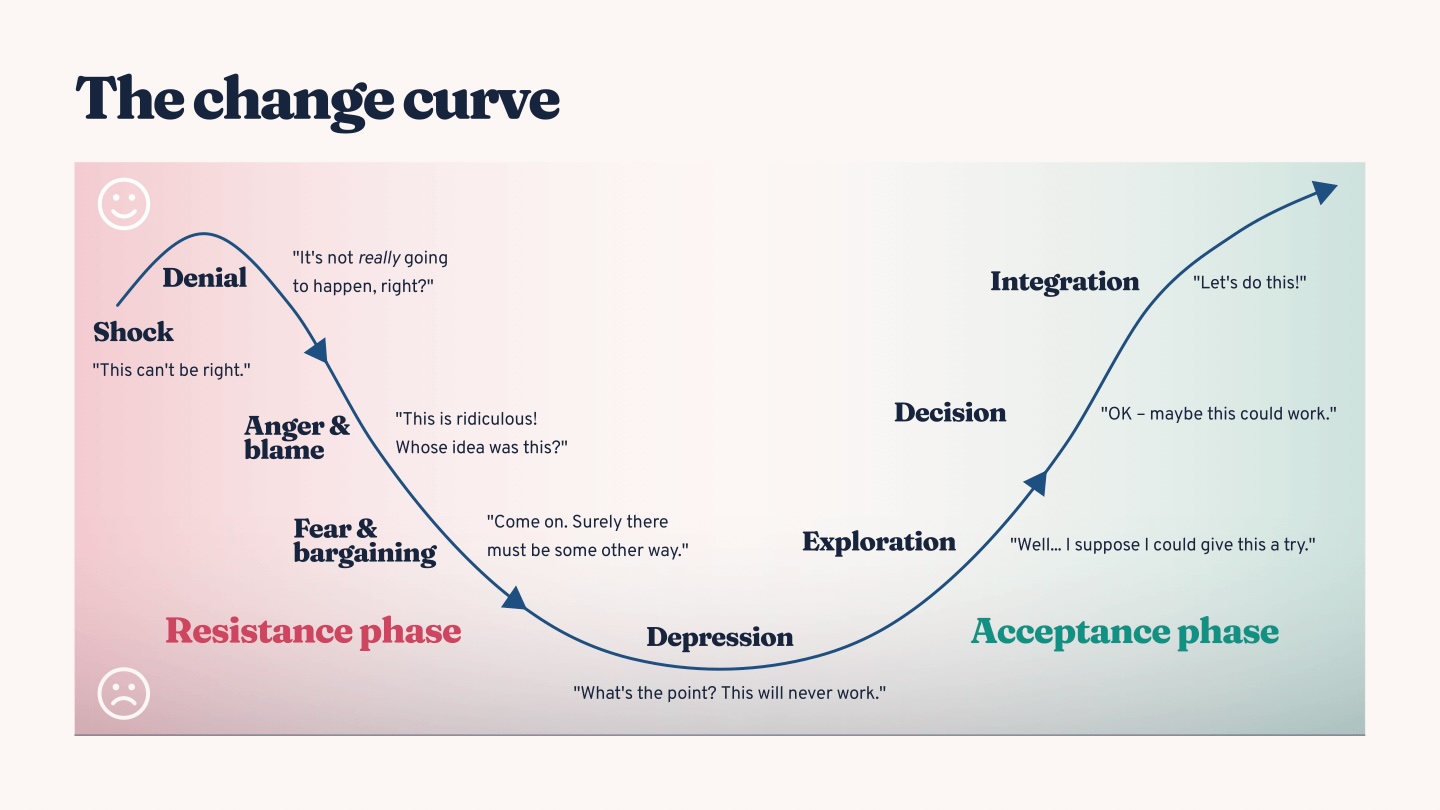
The Kübler-Ross Change Curve was originally developed to describe the emotional stages of grief, but it’s remarkably effective at mapping how teams react to organizational change:
• Denial: “But this is the way we’ve always done it.”
• Frustration / Resistance: Fear of the unknown.
• Exploration / Bargaining: Strategic alignment and openness to discuss change.
• Commitment / Integration: True adoption and forward momentum.
These aren’t signs of dysfunction; they’re a natural part of the process. The Kübler-Ross curve captures the emotional journey. But it’s not a roadmap, it’s a mirror. Leaders must navigate both the psychology and the structure of change in order to either shorten the dip or, ideally, invert it.
While no one expects standardizing physician templates, implementing AI solutions, or redesigning compensation plans to be easy, organizations that invest in co-creation, transparency, and early alignment can significantly accelerate the speed of change. “Organizations that conduct formal change readiness assessments are 2.4x more likely to succeed in transformation.”1
One of the biggest risks? Performative compliance. When leaders or physicians appear to support change but don’t actually buy-in, the real resistance surfaces too late. A readiness check helps prevent that.
Assessing Organizational Readiness
Before launching any major initiative, ask:
• Cognitive: Do people understand the change, and what success looks like (backed by data, not opinion)?
• Emotional: How do we surface and address fears, concerns, and motivations?
• Relational: Do they trust leadership and each other?
• Structural: Are systems, incentives, accountability structures, and roles aligned?
When organizations pause to assess readiness, including aligning leaders, naming fears, and co-designing solutions, they build trust and accelerate results. When they don’t, even the best strategy can stall. Misalignment and resistance often show up after rollout, when it’s much harder to course-correct, which can also translate to a lack of confidence in senior leadership and decreased performance.
Case in Point: Redesigning Physician Compensation
When Ancore was engaged to redesign the physician compensation plan for a large multispecialty group transitioning from health system employment to an independent model, the timeline was compressed to just 45 days, a process that typically takes 6–12 months. The urgency alone sparkedDenial, as both executives and physicians questioned how such a complex, high-stakes change could happen so quickly. In Frustration and Resistance, physicians clung to the familiar health system pay structure tied to market surveys and pushed back against the idea of a P&L-driven model. As the implications became clear, emotions ran high, and conversations often centered on perceived worth versus financial reality.
The turning point came during Exploration and Bargaining, when physicians began asking questions and engaging in co-creation. Once they understood what was within their control, directly or indirectly, they started shaping a model that reflected shared priorities. Finally, through Commitment and Integration, the group moved from defensiveness to ownership. They implemented a new model that maintained market-competitive compensation while securing access to capital and preserving autonomy. What began as a difficult process evolved into a cultural shift toward accountability, transparency, and financial sustainability. When readiness is built in, change doesn’t just happen faster; it endures.
Conclusion: Don’t Skip the Readiness Check
Most leaders think readiness is about messaging. It’s not. It’s about identity, trust, and emotional permission to change. At the same time, change fatigue is real, and it often stems from skipping the emotional groundwork. Before you ask your team to follow, ask yourself if you’ve done the work to make change possible. Build readiness into the process, and change accelerates. Ignore it, and even the right strategy will fail slowly, expensively, and publicly.
Authors:
Eric Passon, CEO, Ancore Health
Addam Marcotte, Managing Principal, FMG Leading